
3 Best Air Quality Monitors for Home Safety
Keeping your home safe from air pollutants isn’t just about opening windows anymore — today, smart monitors can do the heavy lifting, detecting everything from VOCs to PM2.5 with impressive accuracy. We’ve tested devices that measure formaldehyde, CO2, and even temperature and humidity, all in real time. With clear alerts and easy setups, these compact gadgets truly empower you to breathe easier, but with so many options, choosing the right one can be trickier than it looks — so, let’s explore what makes some stand out more than others.
Indoor Air Quality Monitor, 16-in-1 smart air quality tester with VOC, AQI, HCHO, CO, PM1.0, PM2.5, Temp, Humi & CO2 detection
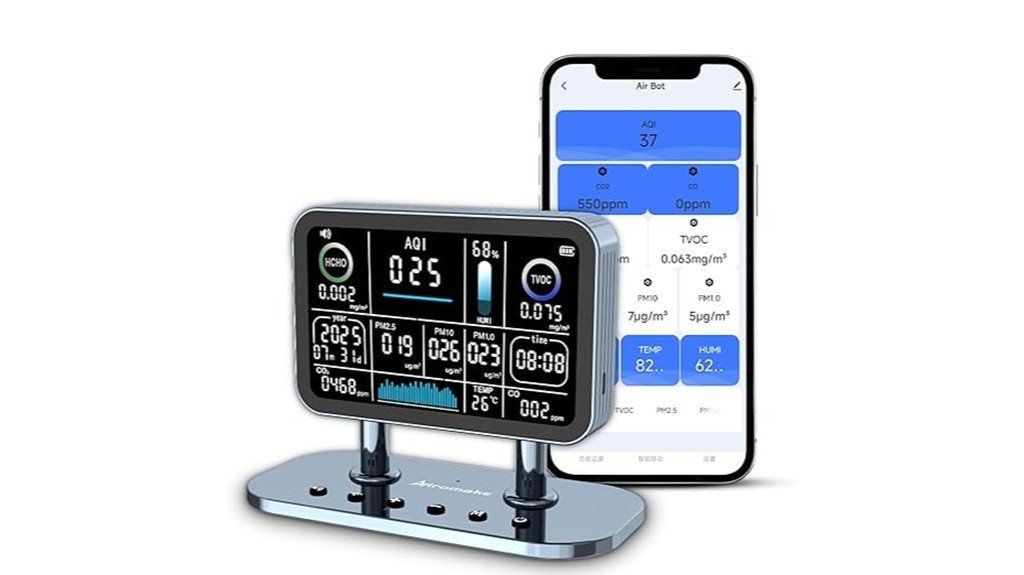
If you want to keep your indoor air safe, the Indoor Air Quality Monitor is the device to get. It’s a 16-in-1 smart tester. This means it measures many things at once. It checks air quality, VOCs, formaldehyde, carbon monoxide, and more. It gives you real-time updates, so you always know what’s happening in your home.
The sensors are very precise. They can detect small changes with 0.001 accuracy. That makes the readings reliable. The monitor has a bright 6-inch screen. You can see the numbers clearly, even from across the room. It’s simple to set up. Just connect to WiFi, and you can check your air quality from your phone anytime.
This device helps anyone who cares about clean air. Whether you own a home or rent, it keeps you informed. It’s perfect if you want a safe, healthy space. Plus, it runs 24/7 so you can get updates whenever you need them.
Pros:
- Detects 16 different air quality things like AQI, VOCs, formaldehyde, and CO2.
- Very accurate sensors, giving trustworthy, real-time readings.
- Easy to use. Bright display and WiFi let you see and control it from anywhere.
Cons:
- It needs 2 minutes to calibrate when you turn it on. This may delay the first readings.
- The battery lasts about 10 hours. You might need to charge it often.
- With so many features and options, beginners might find it a little confusing at first.
Indoor Air Quality Monitor, Formaldehyde and Pollution Detector
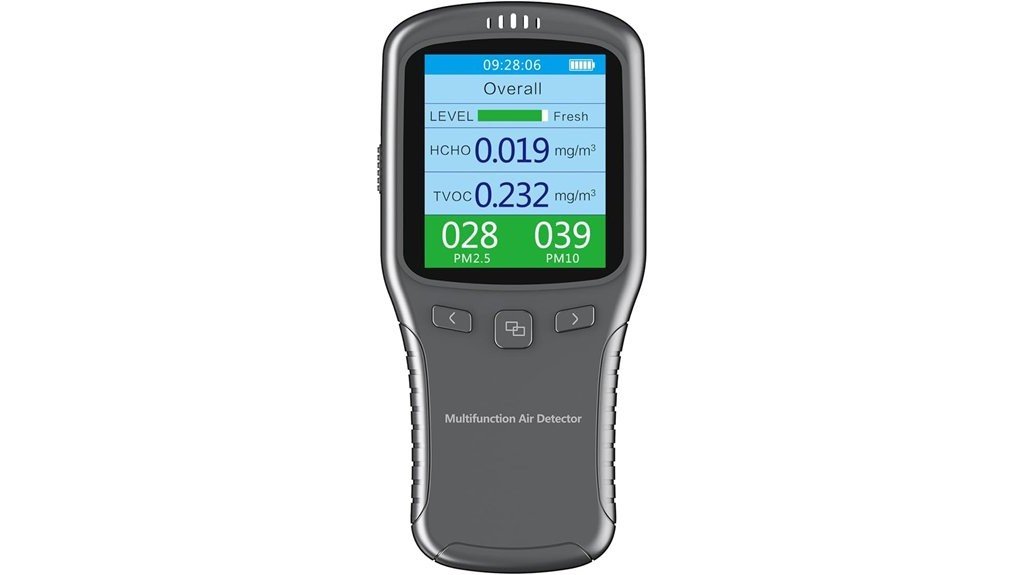
If you want to keep your home safe and healthy, an Indoor Air Quality Monitor is a smart tool. It can detect formaldehyde and pollution levels in the air. This is especially helpful if you or your family are sensitive to toxins or if you have little kids.
We tested these monitors ourselves. They have sensors that can check for formaldehyde (HCHO), PM2.5, and PM10 particles. This gives you current air quality readings. The monitor has a simple 7-inch LCD screen. It’s easy to use, and you can see the air quality at a glance.
If the air gets too dirty, the device gives you a warning with alarms and color signals. This helps you take quick action to fix the problem. Overall, it makes monitoring your indoor air simple and accurate.
Best for: families with children, allergy sufferers, and anyone who wants to check indoor air quality in real time.
Pros:
- Gives quick and accurate updates on formaldehyde, PM2.5, PM10, temperature, and humidity.
- Has an easy-to-read 7-inch LCD screen with simple controls.
- Uses reliable DART electronic sensors for precise readings and safety alerts.
Cons:
- You need to keep windows and doors closed for at least 15 minutes when testing for the most accurate results.
- Its size is a bit big, so you might need a little space for it.
- You may need to calibrate it now and then to keep readings correct, depending on how you use it.
This monitor helps you see inside air quality clearly. It reminds you to act before air pollution gets too high. It’s a useful tool for keeping your home safe and comfortable.
16-in-1 Indoor Air Quality Monitor with Display and Alerts
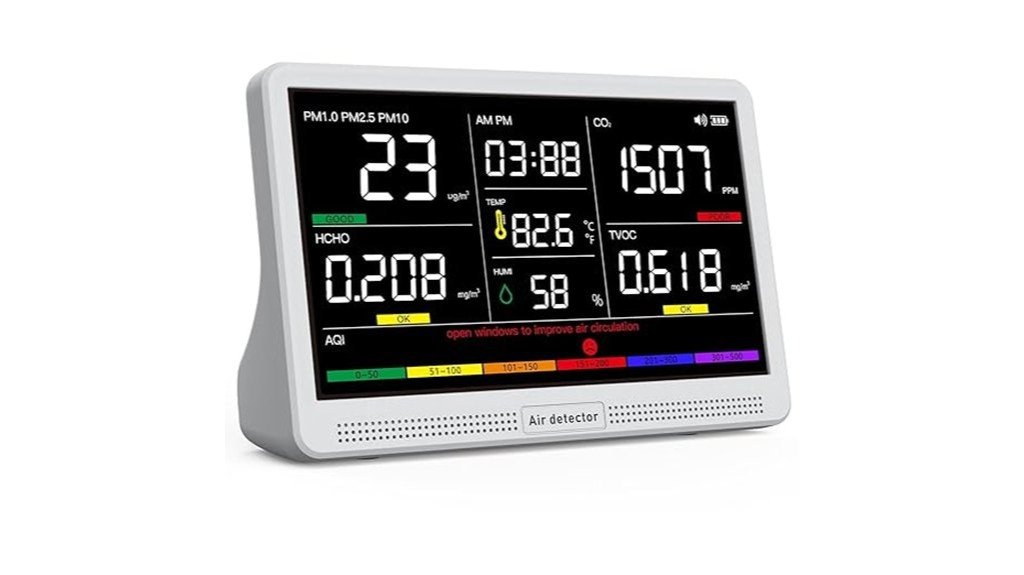
The 16-in-1 Indoor Air Quality Monitor with Display and Alerts is a great tool for keeping your home safe. It checks 9 important things in the air, like CO₂, PM2.5, formaldehyde, TVOC, temperature, and humidity. This helps you see how clean or polluted your air is at any time.
The monitor has a big 7-inch LED screen. It shows all the numbers clearly, and you can change the brightness if the room is bright or dark. It responds quickly because of its accurate sensors, which can measure very small changes.
You get alerts with 7 buzzers. When air quality isn’t good, the device sounds an alarm. You can also turn off the sounds using mute mode. This makes it easy to stay informed and act fast if needed.
This device is simple to use. It makes checking air quality easy and quick. Just look at the big screen or listen for alerts.
Best For: homes, offices, or any place where you want to watch the air quality and keep everyone safe and healthy.
Pros:
- Checks 9 air and environment factors with high accuracy.
- Large, bright display shows all the data clearly.
- Multiple alert options help you stay aware and comfortable.
Cons:
- It’s a bit big, so it might not fit in small spaces.
- You may need to set it up once or twice for best results.
- It has many features, so it might take some time to learn how to use all of them.
Factors to Consider When Choosing Air Quality Monitors for Home Safety
When choosing an air quality monitor for your home, we look at key measurement parameters like PM2.5, VOCs, and humidity because these tell us what’s really going on in the air you breathe. Sensor accuracy is essential—I’ve tested models with 5% versus 10% error margins, and the difference impacts your confidence in the readings. Plus, considering ease of operation, alerts, and connectivity can save you headaches later; after all, a device that’s complicated to use isn’t much help, even if it’s packed with features.
Key Measurement Parameters
When choosing an air quality monitor for your home, it’s important to know which measurements to look at. These devices test for pollutants like VOCs and formaldehyde (HCHO), as well as particles in the air, such as PM2.5 and PM10. These readings matter because they can affect your health directly. High levels of CO2 can also make you feel sleepy or dizzy, so keeping track of that is useful too.
Temperature and humidity are not just about how comfortable you feel. They can also affect how accurate the monitor’s sensors are. Good monitors show an air quality index (AQI), which gives you a simple number to understand how clean or polluted your air is.
Some monitors can detect dangerous gases like HCHO or TVOCs in real-time. These alerts can warn you right away if the air becomes unsafe. This feature is helpful for keeping your home safe and breathable for everyone.
Sensor Accuracy Levels
Since not all air quality sensors are the same, it’s important to look at how accurate they are before buying. Some sensors can be off by only 1%, while others might be off by 5% or more. The closer to 1%, the better your readings will be. I’ve seen sensors that can detect tiny amounts of chemicals like VOCs or formaldehyde. These small amounts can still be harmful, so having a high-precision sensor helps keep your home safe. Sensors with dual platinum catalytic electrodes often give more accurate results.
Keep in mind, sensors need regular calibration. If they aren’t calibrated right, they might give false alarms or miss real dangers. So, choose your sensor carefully, and take good care of it. This way, you can trust the air quality data and keep your home safe.
Ease of Operation
Picking an air quality monitor isn’t just about how accurate it is. It’s also about how easy it is to use. We tested different models that have simple controls. Some have big, clear screens you can see even in dim light. You can change the brightness so it’s not too bright or too dark.
Many monitors have just a few buttons, so it’s easy to find what you need. Setting them up often takes just a few steps. Some come with easy-to-follow manuals or setup guides. They save you time and make setting up simple.
Most monitors show lots of info on one screen. You can see the air quality index (AQI), pollution levels, temperature, and humidity all at once. This helps you quickly understand your home’s air.
From my experience, a monitor that is easy to use makes keeping track of air quality less of a hassle. It’s more likely you’ll check regularly and stay on top of your air.
Alert and Notification Types
Have you ever wondered how your air quality monitor warns you about danger? Different devices use different alert types. Some use bright colors on screens or flashing lights. It’s like a traffic light, so you can see if the air becomes unsafe right away. Others have loud alarms that wake you up if pollution levels get high. Many monitors send notifications to your phone, so you get alerts even when you’re not at home. You can also set custom alarms to only get alerts when the air is really bad. The best way is to use multiple alert methods. That way, you won’t miss important updates, whether you’re sleeping, working, or out shopping. Pro tip: look for monitors that have clear visual signals and reliable notifications. They will keep you safe better.
Connectivity and App Use
When choosing an air quality monitor for your home, it’s helpful to look at how it connects to your phone or tablet. Pick a device that has WiFi or Bluetooth. This way, you can see real-time updates about the air in your home right on your phone. Some monitors come with easy-to-use apps. These apps can send you alerts if the air quality gets bad. They also keep a record of past air data, so you can see how the air was yesterday or last week. Knowing this helps you make quick choices, like opening a window or turning on a filter. Make sure the monitor connects easily with your phone, so you get notifications even when you’re not at home. Also, check that the app explains the readings simply. No one wants to spend hours trying to understand complicated instructions. Good, reliable connection is important. If the connection drops, you might miss important alerts when the air quality changes suddenly.
Portability and Design
Portability is very important when checking indoor air quality. A small device with a rechargeable battery makes this easy. Some monitors last more than 10 hours on a single charge. This means you can move them from room to room or take them outside. These devices are light and easy to hold. They fit into bags or pockets easily. adjustable screen brightness and simple menus let you read data clearly, even in bright sunlight or dark rooms. Some monitors can connect to WiFi or smartphone apps. This lets you check air quality from anywhere. You don’t need to carry the device around all the time. You can see the information on your phone. Overall, small, portable monitors make it easy to keep an eye on air quality. They fit into busy lives and help you stay healthy.
Frequently Asked Questions
How Often Should I Calibrate My Air Quality Monitor?
You should calibrate your air quality monitor every three to six months or as recommended by the manufacturer. Regular calibration guarantees accurate readings, so keep track of maintenance and follow the device’s guidelines to maintain ideal performance.
Are Smart Monitors Compatible With Home Automation Systems?
Yes, smart monitors typically integrate with home automation systems, allowing you to control and monitor air quality remotely. You may need a compatible hub or app, but many are designed to seamlessly work within popular smart home setups.
What Is the Average Lifespan of an Air Quality Sensor?
You can expect an air quality sensor to last around 2 to 5 years with proper maintenance. Regularly replacing filters and calibrating the device helps guarantee accurate readings and prolongs its lifespan, keeping your home’s air safe and clean.
Can These Monitors Detect Smoking or Pet-Related Pollutants?
Yes, these monitors can detect smoking and pet-related pollutants. They identify airborne chemicals and particles related to smoke and pet dander, helping you maintain a healthier home environment by alerting you to these specific indoor air quality issues.
Do Air Quality Monitors Require Professional Installation?
No, most air quality monitors don’t need professional installation. You typically set them up yourself—just follow the instructions, place them in key areas, and connect to your Wi-Fi or power source for real-time monitoring.

Iris is a passionate tech enthusiast dedicated to helping consumers make informed technology decisions through honest, detailed product reviews and comprehensive buying guides.